About India FDI Watch
India FDI Watch is building awareness and facilitating grassroots action to prevent the take-over of India's retail sector by corporations. We are building Joint Action Committees (JAC) led by those who will be most affected, mainly; trade associations, unions, hawkers organizations, farmers groups and small scale industries.
A National Streering Committee has formed in Delhi, of which India FDI Watch is a facilitator and member. The National Steering Committee has come under the banner Vyapaar Rozgaar Bachao Andolan. Similarly in Mumbai, India FDI Watch is a chair and member of the Vyapaar Rozgaar Suraksha Kriti Samiti. In Bangalore, India FDI Watch is a key member and coordinator of the Karnataka Joint Acton Committee Against Corporate Retail.
The National Steering Committee is working with partners across the country and the Joint Action Committees, based in Mumbai and Bangalore to facilitate broad-based action at the local and national level and to develop policy demands that will ensure the protection or enhancement of those people who stand to be most impacted. Over the next year India FDI Watch will work with the National Steering Committee to expand the grassroots base of the campaign by partnering with mass-based groups across the country.
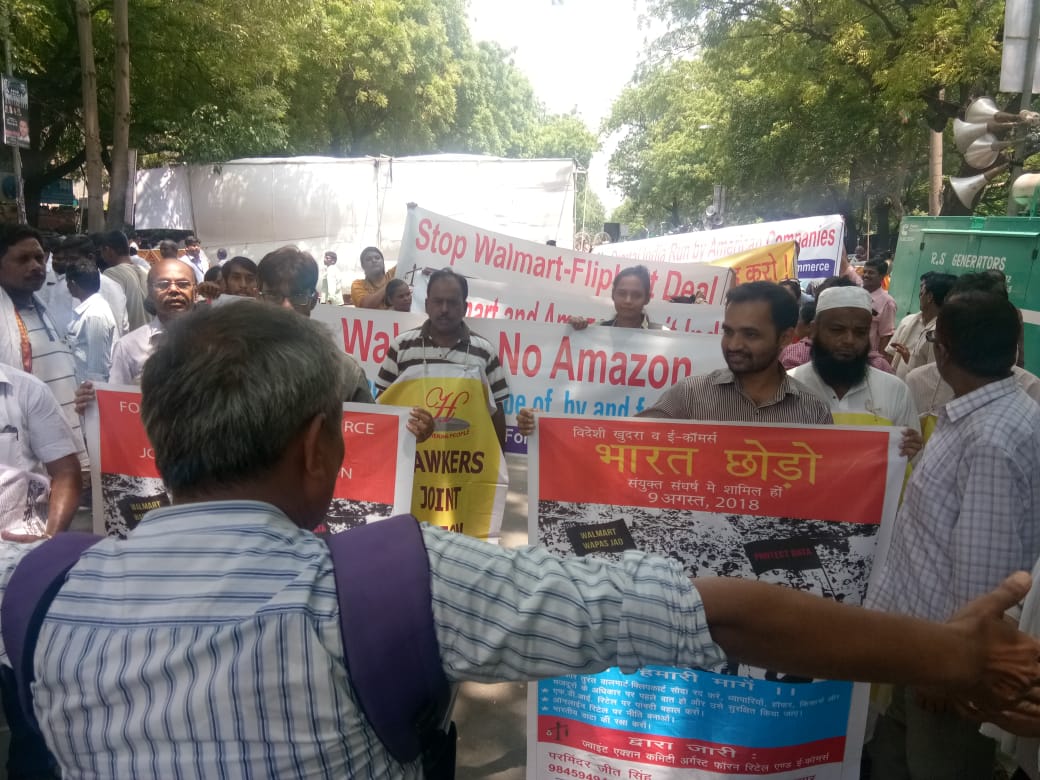
India FDI Watch has been key in coordinating and organizing national actions; mainly the February 22nd actions against thde Wal-Mart Vice Chairman's arrival in India to sign the Joint Venture with Bharti. On August 9th, 2007, India FDI Watch again organized national, state, and local partners for a National Day of Action, calling on "Corporations to Quit Retail."
A call has been given to all the partners to hold demonstrations before corporate stores on 23rd February, 2008. India FDI Watch will join and facilitate a mass rally in Delhi on 4th March 2008 against corporate retail. A call for all India Trade Strike will be given in the Delhi Rally.
For more information, download the India FDI Watch Brochure (in English).
For more information, download the India FDI Watch Brochure (in Hindi)
For more information, download the India FDI Watch Brochure (in Kannada.)
For more information, download the India FDI Watch Brochure (in Malayam).
For more information, download the India FDI Watch Handbill (in English)
For more information, download the India FDI Watch Handbill (in Hindi)
Download our stickers here! 
PRESS STATEMENT 'QUIT RETAIL' RALLY

One Lakh Traders, Mathadi Workers, Hawkers to Join “Quit Retail Rally” at Azad Maidan on 10th October 2007, 10 am.
To give war cry for “Corporations Quit Retail”, “Scrap Model APMC Act”, “Oppose FDI in Retail” “Implement National Policy for Hawkers”, “Oppose the Bharti-Walmart Joint Venture”, “Demand a National Retail Policy” and “Scrap Wholesale Cash n Carry licenses issued to Metro and Shoprite”
To read the rest, click here.

Thousands protested to oppose the Bharti-Walmart Joint Venture
On the heels of the announcement of the Bharti-Walmart joint venture, thousands of traders, hawkers, farmers and workers protested across India. Protesters also included a group of American students who demanded that Wal-Mart not be allowed into India. Mass-based organizations called on the Prime Minister and Sonia Gandhi to immediately stop the Bharti-Walmart Joint Venture and not allow Wal-Mart’s backdoor entry into India. There was also a strong united call on all corporations—both foreign and domestic—to "Quit Retail". The protests were timed to commemorate the start of the "Quit India" movement, which started on August 9, 1942, with mass-based sections of society drawing parallels to the East India Company and companies like Wal-Mart, Bharti and Reliance.
Agitations took place in the metro cities of Delhi, Mumbai, Bangalore and Kolkata along with other major cities including, Kalicut, Bhopal, Jaipur, Ranchi, Balia, Meerath, Sonipat, Nagpur, Nasik, Pune and Indore.
In Delhi, thousands of traders, hawkers, farmers and workers protested in Chandni Chowk, a historical market, and burned effigies of Wal-Mart, Bharti and Reliance. Dharmendra Kumar, Director of India FDI Watch and national coordinator of the Vyapaar Aur Rozgaar Bachao Andolan conducted the proceedings and told the agitators, "Both Sonia Gandhi and Manmohan Singh have acknowledged the dangers of corporations entering into the retail sector. The Govt. has commissioned a report looking at the impact of the entire supply chain on livelihoods after Sonia Gandhi had written a letter of caution. Sonia Gandhi had also publicly refused to meet with Michael Duke, Wal-Mart Vice-Chairman during his visit in February after public demonstrations were held due to his arrival. However, both Sonia Gandhi and the PMO have remained silent on the Bharti-Wal-Mart deal and though they have publicly cautioned against corporations and commissioned a study, they have taken no subsequent actions. He demanded that the Wal-Mart Bharti joint venture should be immediately revoked and all corporations should be stopped until thorough study has been conducted by an independent special task force comprising of stakeholders."
Shyam Bihari Mishra, President, Bhartiya Udyog Vyapar Mandal refered back to the British Raj, stating, "The East India Company, the most powerful company at the time, came to colonize India’s people and domestic and international trade and now Wal-Mart, the world’s largest company is trying to enter India to do the same. Mr. Mishra said India has a history of resistance, our people threw out the British and sixty years later if millions have their businesses and livelihoods threatened we will do the same now. He announced that family members of traders would boycott corporate stores." Praveen Khandelwal, General Secretary, Confederation of All India Traders (CAIT) said "The livelihoods of retail traders are at stake. If big retail giants like Wal-Mart and Reliance come into the country, small traders would be finished." A mass campaign would be launched to strike back and make corporations realise that we will not let them ruin our livelihoods, he said.
Vandana Shiva, Director, Navdanya said "India is a land of retail democracy- hundreds of thousands of weekly haats and bazaars are located across the length and breadth of our country by people’s own self-organizational capacities. In a country with large numbers of people, and high levels of poverty, the existing model of retail democracy is the most appropriate in terms of economic viability and ecological sustainability.".
Shaktiman Ghosh, General Secretary, National Hawkers Federation warned the government "about taking such strong stances against India’s millions of hawkers and small shopkeepers in favor of only a few huge corporations who seek to dominate the Indian retail market."
Mr. Indu Prakash of Campaign for Judicial Accountability and Reform revealed the nexus between judiciary and corporate retail which led to the ceiling of shops of more than one hundred thousands of traders of Delhi and still goes on.
Mr. Bhati of Bhartiya Mazdoor Sangh, Delhi, Harbhajan Singh Siddhu, National Secretary, Hind Mazdoor Sabha, Sunil Kansal, Secretary, Rashtriya Vyapar Mandal, Hakim Singh Rawat, General Secretary, Delhi Hawkers Welfare Association, Banwari Lal Sharma, President, Aazadi Bachaon Aandolan, R K Sharma, Secreatry, UTUC-Lenin Sarani and Venkatesh of Lok Raj Sangathan also addressed the protesters in Delhi.
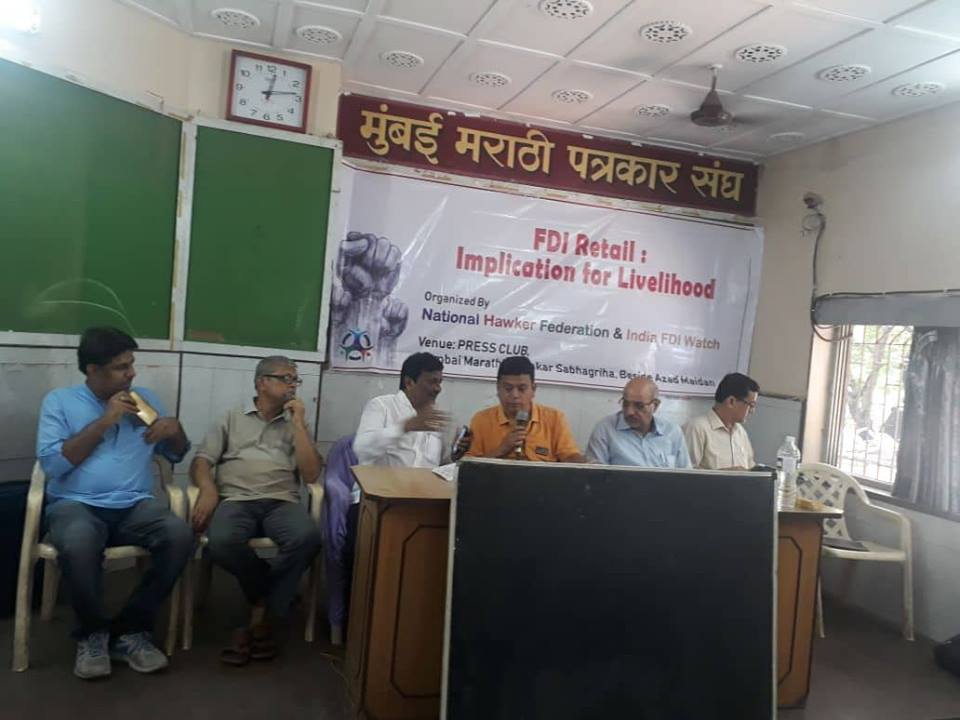
In Mumbai, thousands of retailers, hawkers, workers and cooperatives participated in a one day trade bandh and a mass public event organized by the Vyapaar Rozgaar Suraksha Kriti Samiti, a joint action committee of trade associations, hawkers groups, trade unions and others. Leaders of Federation of Associations of Maharastra (FAM), Retail and Dispensing Chemists Association (RDCA), India FDI Watch, Mumbai Mahanagar Vyapari Seva Parishad (MMVSP), Mumbai Vyapar Mahasang (MVM), Apna Bazaar, National Hawkers Federation, Center of Indian Trade Unions (CITU) and Hind Mazdoor Kisan Panchayat (HMKP) addressed the protesters. Mohan Gurnani, Convener of the Mumbai based Vyapaar Rozgaar Suraksha Kriti Samiti and President of the Federation of Associations of Maharastra (FAM) said "organised retaling would leave 20 crore people without jobs. Let the government first come out with a rehabilitation for these people and then it can open up FDI in retail". Kishore Shah, President of the Mobile & Telecom Retailers and Distributors Association (MTRDA), stated that around 12,000 retail shop-keepers deal in SIM cards and recharge vouchers of Air-Tel in Mumbai, generating business worth crores of rupees every day. Mr. Shah said "We have already informed all our members, distributors and wholesalers against selling any Airtel products". The Mumbai APMC—wholesale— market remained closed, along with thousands of retail shops across the city, including all chemists and druggists shops. Apna Bazaar, Maharastra’s largest cooperative store also downed its shutters and wholesale markets remained closed in Nasik and Pune. At an evening event at Shanmukananda Hall in Mumbai mass-based groups laid out a future course of action and adopted a charter of demands. They called on the Center to immediately repeal the Wholesale Cash-n-Carry Permission, and all licenses granted under the permission; repeal the APMC Model Act, implement the National Policy on Street Vendors, take measures against predatory pricing and formulate a national policy on retail trade and small scale industries.
In Bangalore thousands protested at the town hall and burned effigies of corporate retailers like Wal-Mart and Reliance. The protest culminated in leaders presenting the Governor with a memorandum calling on the state to repeal the recent passage of the APMC Model Act. A Charter of Demands, same as was passed in Mumbai, was also placed before the District Collector. Smaller protests were organized throughout the state in different districts including Kodagu, Bijapur, Gulbarga and Davangere districts.
In Jaipur fifty American students joined with hawkers demanding that Wal-Mart leave India and demanding implementation of the National Policy on Street Vendors. The American students and hawkers demonstrated in the old city and held signs saying "Americans Oppose Wal-Mart Everywhere". Ms. Cheryl, an American citizen, learning Hindi at Jaipur said that Wal-Mart has a disastrous impact on small shopkeepers and neighbourhood communities in America and called Indians to learn from their experience and not to allow Wal-Mart to operate in India. Ms. Cheryl said that the world is moving from ‘Corporate to Cooperative’ and Indians should not corporatize their cooperatives.
In Kerala the Kerala Vyapari Vyavasayi Egono Samiti organized protest marches in over 1000 places across the state. In Kalicut over 10,000 traders protested in front of the corporation’s office and submitted a memorandum demanding that corporations keep out of retail and the immediate halt to Wal-Mart’s backdoor entry and the repeal of the Wholesale Cash-N-Carry permission.
In Kolkata the Federation of Trade Organizations (FTO) of West Bengal organized protests in all the 12 districts of the city along with protests across West Bengal, including in front of malls. Tens of thousands traders participated in the protest. In the evening, thousands of hawkers took out a protest march from the city museum.
In Ranchi, Uday Shankar Ojha who led the vegetable vendors before Reliance Fresh in May and has only recently been released from Jail, led thousands of hawkers and vegetable vendors at Albert Ekka Chowk in Ranchi, demanding that Reliance Fresh and all other corporations leave the retail sector and "withdraw their sinister plans to displace millions of livelihoods".
In Bhopal there was a state-level protest meeting in the morning at Gandhi Bhavan and traders sat on a dharna at Roshanara Chowk in the afternoon and burn effigies of Wal-Mart, Bharti and Reliance. A call for Bhopal Bandh was given for 21 August to oust corporate from retail trade.
Similar protests were organized in other cities including Allahabad, Lucknow, Meerut, Bagpat and Sonipat. 
VYAPAR ROZGAR SURAKSHA KRITI SAMITI
Tuesday, 18th December, 2007
In a daring action more then 10,000 mathadi workers ,Traders, Hawkers blocked the main avenue in sector 17, Navi Mumbai today at 4pm , this traffic intersection is also known as Arenja Chowk, completely paralysing the traffic in this satellite town of Mumbai.The effect of this blockade was felt for several hours and the Traffic upto Mumbai was severely affected.
The sight of the 10,000 strong procession as it wound its way gathering momentum like a river comming down a mountain shocked the onlookers policemen who had gathered in hundreds to stop the procession from going to the main Mumbai-Pune highway as announced by the samiti, the look on the policemen said it all, as they wondered that if this disciplined procession were to decide to break the cordon and move to the highway the policeforce gathered would not have been able to stop them.
The procession was led by a Truck on which a live D.J belted out songs and slogans from the professional sound system ( which is normally seen in Ganpati festivals and carnivals) was a first of its kind seen in any protest procession in the city. The leaders led by Shri Mohan Gurnani, Shri Narendra Patil, Shri Sharad Maru, Shri Ashok Baria gave slogans and kept the crowd going.
The procession went thru all the wholesale markets of vegetable, grain fruits which supply the entire agricultural supplies to the 1,30,00,000 population of Mumbai, all the markets closed down their shutters and for the first time both traders and their employees joined the procession in response to the joint appeals and slogans of the Traders and workers.
With every passing market the crowd grew, as it reached the Arenja chowk the procession was surrounded by the waiting policemen and state reserve police and the samiti was asked to stop their procession and not proceed towards the highway, fearing largescale violence the organisers decided that they would end the procession in the middle of the traffic intersection and have a meeting , in a quick conversion one of the busiest streets of Navi Mumbai bccame the open air venue of a protest meeting to demand the national policy to protect retail trade and livelihoods of the workers.
As leaders from the Samiti climbed on to the traffic island which became a temprorary dias the crowd of 10,000 settled down and squatted on the streets, all the overlooking commercial buildings stopped their activity as business came to a standstill, there were people standing on their balconies and terraces watching this gathering in the middle of the intersection.
All the speakers from the samiti and the supporting organisations condemned the State and Central government for not being able to protect the livelihoods and stop the entry of national corporations i.e Reliance, Subiksha, More etc and multinationals i.e Wallmart , Metro etc. into the retail trade. They warned the State government and the chief Minister that if they did not get a response within 8 days , the samiti would take millitant action and block traffic in diffrent places and move the protests at the doorsteps of the Corporations.
The protest ended peacefully with a call fom all organisations to take a delegation to meet the C.M and demand action in the next few days , the meeting which was well covered by the print and electronic media ended in slogans of " Go Back Wall-Mart" and " Corporations Quit Retail".
Dare To Struggle Dare To Win.
Vinod Shetty. India FDI Watch 
Rathke's Take: Big is not beautiful in retail
Published in the Economic Times, 29 September
IS RELIANCE Retail going the Wal-Mart way? The opposition to Reliance’s retail business in India is quite similar to the opposition that Wal-Mart has generated in the US. This similarity becomes even more obvious when one looks at the ways in which activists have initiated their campaign. Not only is the modus-operandi common, even the people spearheading the activities are veteran anti-Wal-Mart activists.
Wade Rathke, undisputably the most prominent and vocal opponent of Wal-Mart internationally, has been in regular touch with the leaders of the India FDI Watch campaign. Mr Rathke is the chief organiser of Association of Community Organisations for Reform Now (ACORN) which also mobilised the public in South Korea and Germany, the two markets from where Wal-Mart subsequently withdrew. “I have been in touch with various stakeholder groups in India, including small traders, farmers and suppliers,” says Mr Rathke.
It is interesting to note that the campign is targeting farmers as well, because the biggest benefit ascribed to organised retail is that farmers will get a better price for their produce. However, Mr Rathke has a different take on this issue. “The farmers need to understand the long-term plan of these corporates. Once a farmer is into this vicious circle, may be 2-3 years down the line, he will be left with no option but to surrender his land to one of these corporate giants,” he says.
Mr Rathke has been a professional campaign organiser for the last 35 years and has founded a series of organisations on the issues of social justice and worker rights. He also spearheads a union of Wal-Mart workers, though the company has not accorded official recognition to the forum. ACORN is one of the largest community organisations in the US. Mr Rathke has been particularly vocal against Wal-Mart’s labour practises in the US, having initiated a series of litigations and labour movements against the Bentonville retailer, which has on many occasions, been in the line of fire for violating labour laws in the US, Canada and some European countries. In January 2006, Wal-Mart had to pay $135,540 to settle federal charges that it violated child labour laws in Connecticut, Arkansas and New Hampshire. Still earlier, in March 2000, the company was fined $205,650 for violations of labour laws in one out of every 20 stores in the state of Maine, US. 
Thousands protested to oppose the Bharti-Walmart Joint Venture
On the heels of the announcement of the Bharti-Walmart joint venture, thousands of traders, hawkers, farmers and workers protested across India. Protesters also included a group of American students who demanded that Wal-Mart not be allowed into India. Mass-based organizations called on the Prime Minister and Sonia Gandhi to immediately stop the Bharti-Walmart Joint Venture and not allow Wal-Mart’s backdoor entry into India. There was also a strong united call on all corporations—both foreign and domestic—to "Quit Retail". The protests were timed to commemorate the start of the "Quit India" movement, which started on August 9, 1942, with mass-based sections of society drawing parallels to the East India Company and companies like Wal-Mart, Bharti and Reliance.
Agitations took place in the metro cities of Delhi, Mumbai, Bangalore and Kolkata along with other major cities including, Kalicut, Bhopal, Jaipur, Ranchi, Balia, Meerath, Sonipat, Nagpur, Nasik, Pune and Indore.
In Delhi, thousands of traders, hawkers, farmers and workers protested in Chandni Chowk, a historical market, and burned effigies of Wal-Mart, Bharti and Reliance. Dharmendra Kumar, Director of India FDI Watch and national coordinator of the Vyapaar Aur Rozgaar Bachao Andolan conducted the proceedings and told the agitators, "Both Sonia Gandhi and Manmohan Singh have acknowledged the dangers of corporations entering into the retail sector. The Govt. has commissioned a report looking at the impact of the entire supply chain on livelihoods after Sonia Gandhi had written a letter of caution. Sonia Gandhi had also publicly refused to meet with Michael Duke, Wal-Mart Vice-Chairman during his visit in February after public demonstrations were held due to his arrival. However, both Sonia Gandhi and the PMO have remained silent on the Bharti-Wal-Mart deal and though they have publicly cautioned against corporations and commissioned a study, they have taken no subsequent actions. He demanded that the Wal-Mart Bharti joint venture should be immediately revoked and all corporations should be stopped until thorough study has been conducted by an independent special task force comprising of stakeholders."
Shyam Bihari Mishra, President, Bhartiya Udyog Vyapar Mandal refered back to the British Raj, stating, "The East India Company, the most powerful company at the time, came to colonize India’s people and domestic and international trade and now Wal-Mart, the world’s largest company is trying to enter India to do the same. Mr. Mishra said India has a history of resistance, our people threw out the British and sixty years later if millions have their businesses and livelihoods threatened we will do the same now. He announced that family members of traders would boycott corporate stores." Praveen Khandelwal, General Secretary, Confederation of All India Traders (CAIT) said "The livelihoods of retail traders are at stake. If big retail giants like Wal-Mart and Reliance come into the country, small traders would be finished." A mass campaign would be launched to strike back and make corporations realise that we will not let them ruin our livelihoods, he said.
Vandana Shiva, Director, Navdanya said "India is a land of retail democracy- hundreds of thousands of weekly haats and bazaars are located across the length and breadth of our country by people’s own self-organizational capacities. In a country with large numbers of people, and high levels of poverty, the existing model of retail democracy is the most appropriate in terms of economic viability and ecological sustainability.".
Shaktiman Ghosh, General Secretary, National Hawkers Federation warned the government "about taking such strong stances against India’s millions of hawkers and small shopkeepers in favor of only a few huge corporations who seek to dominate the Indian retail market."
Mr. Indu Prakash of Campaign for Judicial Accountability and Reform revealed the nexus between judiciary and corporate retail which led to the ceiling of shops of more than one hundred thousands of traders of Delhi and still goes on. Mr. Bhati of Bhartiya Mazdoor Sangh, Delhi, Harbhajan Singh Siddhu, National Secretary, Hind Mazdoor Sabha, Sunil Kansal, Secretary, Rashtriya Vyapar Mandal, Hakim Singh Rawat, General Secretary, Delhi Hawkers Welfare Association, Banwari Lal Sharma, President, Aazadi Bachaon Aandolan, R K Sharma, Secreatry, UTUC-Lenin Sarani and Venkatesh of Lok Raj Sangathan also addressed the protesters in Delhi.
In Mumbai, thousands of retailers, hawkers, workers and cooperatives participated in a one day trade bandh and a mass public event organized by the Vyapaar Rozgaar Suraksha Kriti Samiti, a joint action committee of trade associations, hawkers groups, trade unions and others. Leaders of Federation of Associations of Maharastra (FAM), Retail and Dispensing Chemists Association (RDCA), India FDI Watch, Mumbai Mahanagar Vyapari Seva Parishad (MMVSP), Mumbai Vyapar Mahasang (MVM), Apna Bazaar, National Hawkers Federation, Center of Indian Trade Unions (CITU) and Hind Mazdoor Kisan Panchayat (HMKP) addressed the protesters. Mohan Gurnani, Convener of the Mumbai based Vyapaar Rozgaar Suraksha Kriti Samiti and President of the Federation of Associations of Maharastra (FAM) said "organised retaling would leave 20 crore people without jobs. Let the government first come out with a rehabilitation for these people and then it can open up FDI in retail". Kishore Shah, President of the Mobile & Telecom Retailers and Distributors Association (MTRDA), stated that around 12,000 retail shop-keepers deal in SIM cards and recharge vouchers of Air-Tel in Mumbai, generating business worth crores of rupees every day. Mr. Shah said "We have already informed all our members, distributors and wholesalers against selling any Airtel products". The Mumbai APMC—wholesale— market remained closed, along with thousands of retail shops across the city, including all chemists and druggists shops. Apna Bazaar, Maharastra’s largest cooperative store also downed its shutters and wholesale markets remained closed in Nasik and Pune. At an evening event at Shanmukananda Hall in Mumbai mass-based groups laid out a future course of action and adopted a charter of demands. They called on the Center to immediately repeal the Wholesale Cash-n-Carry Permission, and all licenses granted under the permission; repeal the APMC Model Act, implement the National Policy on Street Vendors, take measures against predatory pricing and formulate a national policy on retail trade and small scale industries.
In Bangalore thousands protested at the town hall and burned effigies of corporate retailers like Wal-Mart and Reliance. The protest culminated in leaders presenting the Governor with a memorandum calling on the state to repeal the recent passage of the APMC Model Act. A Charter of Demands, same as was passed in Mumbai, was also placed before the District Collector. Smaller protests were organized throughout the state in different districts including Kodagu, Bijapur, Gulbarga and Davangere districts.
In Jaipur fifty American students joined with hawkers demanding that Wal-Mart leave India and demanding implementation of the National Policy on Street Vendors. The American students and hawkers demonstrated in the old city and held signs saying "Americans Oppose Wal-Mart Everywhere". Ms. Cheryl, an American citizen, learning Hindi at Jaipur said that Wal-Mart has a disastrous impact on small shopkeepers and neighbourhood communities in America and called Indians to learn from their experience and not to allow Wal-Mart to operate in India. Ms. Cheryl said that the world is moving from ‘Corporate to Cooperative’ and Indians should not corporatize their cooperatives.
In Kerala the Kerala Vyapari Vyavasayi Egono Samiti organized protest marches in over 1000 places across the state. In Kalicut over 10,000 traders protested in front of the corporation’s office and submitted a memorandum demanding that corporations keep out of retail and the immediate halt to Wal-Mart’s backdoor entry and the repeal of the Wholesale Cash-N-Carry permission.
In Kolkata the Federation of Trade Organizations (FTO) of West Bengal organized protests in all the 12 districts of the city along with protests across West Bengal, including in front of malls. Tens of thousands traders participated in the protest. In the evening, thousands of hawkers took out a protest march from the city museum.
In Ranchi, Uday Shankar Ojha who led the vegetable vendors before Reliance Fresh in May and has only recently been released from Jail, led thousands of hawkers and vegetable vendors at Albert Ekka Chowk in Ranchi, demanding that Reliance Fresh and all other corporations leave the retail sector and "withdraw their sinister plans to displace millions of livelihoods".
In Bhopal there was a state-level protest meeting in the morning at Gandhi Bhavan and traders sat on a dharna at Roshanara Chowk in the afternoon and burn effigies of Wal-Mart, Bharti and Reliance. A call for Bhopal Bandh was given for 21 August to oust corporate from retail trade.
Similar protests were organized in other cities including Allahabad, Lucknow, Meerut, Bagpat and Sonipat. 
Hunger strike against corporate retail in Chennai
 |  | 
 Mr. T. Vellaiyan, President of Tamil Nadu Vanigar Sangankalin Peravai
|
June 15th 2007
Chennai, Tamil Nadu—At around 9am on 15th of June 2007 around 800 people gathered near the Chepauk Cricket Stadium opposite of the Government guest house shouting slogans against the WTO, neo-liberal trade agreements and the rise of corporate retail. The government of Tamilnadu has given permission to corporate retailers like Reliance, ITC and others contract directly with farmers and do business on a massive-scale, with out putting any restrictions that may protect the livelihoods of farmers and those already involved in the retail trade.
The hunger strike was organized by the Tamil Nadu Vanigar, Samgankalin Peravar (Tamil Nadu Traders’ Association Federation), headed by T. Vellaiyan. The Tamil Nadu Traders’ Association is a mass based organization, which has been resisting the entry of foreign retailers and growth of corporate retail for many years.
Traders from different districts of the state assembled at the venue. All the traders wore white shirt and white dhoti and created an atmosphere that resembled the days of the independence movement struggle. T. Vellaiyan addressed the media people about the purpose of the hunger strike.
T. Vellaiyan cited the examples of the WTO and other trade agreements supported by the Center government that are facilitating the entry of corporations into the retail sector. He said that “this is why our traders, hawkers and other stake holders are on the streets, today because big corporate companies are pushing us to the streets. We are opposing the state government and the central government in this regard.”
Mr. Vellaiyan, went on, “We know how to do business of tamarind, we know where the goods are coming to the state and our markets, how to supply and to do business has been learnt through our experiences of forefathers. We are not from different countries are born here and going to die here. We are not asking government to give loans or subsidies; in turn we pay regular taxes. The companies, which are entering in to retail are getting more benefits from the governments.”

April Seminar on the APMC Amendment Act
 |  | 
 Mr. Doraiswamy
|  | 
 Seminar leaders
|
In January 2007, The India FDI Watch campaign began to build awareness on FDI in retail and the effect of entry of Wal-Mart and other companies in the retail trade across the communities of traders, hawkers, street vendors, vegetable merchants, unions, NGO`s and the affected communities by raising awareness among the Stake holders.
In April 21st, 2007 a seminar was organized in Bangalore the capital city and IT Hub of Karnataka, which is the fastest developing city in Asia. The present trend in retail business shows that multinational companies and national companies are planning to enter into the retail business, and already Metro Cash & Carry, a Germany-based company, has started business in Bangalore while the national companies like Reliance, Fabmall (Aditya Birla group) Big Bazar, Food Bazar, Food World, Spencer and other hyper malls have opened their stores. The present law is governed by the Agriculture Produce Marketing Committee (APMC) of Karnataka which was constituted by the Government of Karnataka in 1960`s to manage the trade affairs in the local market. APMC is a democratic body elected by the members of traders and farmers. To pave the way for FDI in retail and contract farming in agriculture, the Government of Karnataka is planning to amend the present act by introducing the Model APMC act, which was introduced by the Central government of India.
Seminar on APMC AMENDMENT ACT AND CORPORATE RETAIL: Impact on Agriculture, Retail and Workers, 21st April 2007, SCMI house, Bangalore.
Freedom fighter and noted intellectual of Karnataka Mr. Doraiswamy inaugurated the seminar by launching a signature campaign, symbolically by signing against the APMC amendment act and corporate retail. He opposed the government because it is not considering the realities of the present situation. He further stated that FDI in retail would have adverse effects & consequences on the agriculture sector, retail sector and the related workforces. He also stressed the need for another struggle to ensure the freedom in the agricultural sector, retail and unorganized employment sector.
KRRS Karnataka Rajya Raitha Sanga (Farmers movement of Karnataka) leader Mrs Sunanda Jayaram told, that the amendment in the APMC act would affect the farmers as the act will bring in contract farming and throw the agricultural trading outside the government control, eliminating the small farmers and leading to concentration on the land with a few big companies. She also questioned whether the farmers asked the government for the amendment in the act? Which the government claims is farmer friendly. Without consulting the main stake holders like farmers, traders, workers and other dependent people government should not amend the present act and allow the corporate retail or FDI in retail business. She further added that we should not allow any amendment which would have a negative impact on our livelihood; KRRS will support the present campaign and will be a partner in efforts. Mr. Anandam past president of FKCCI chaired the session and told the gathering that the present government is not considering the traders and treating the traders as nobody, and we are opposing the move of the government. He further stated that united struggle is needed to pressurize the government not to take any steps to amending the act; traders will be part of the struggle and will be active in the process of raising voice against the APMC amendment and corporate retailing.
Mr. G.R. Shivashankar, chair person, TUCC (Trade union coordination committee) told that we know how to do retail business because we are having generations of experience in retail and in agricultural but nowadays Wal-Mart and Reliance is teaching us the business of retail, we oppose this. Our hawkers, small trade retailers, street vendors, and the big traders will lose their livelihood because of the entry of MNC’s and national companies which have targeted our livelihood options. I further call upon the government not to amend the act, which is providing free space to contract farming and FDI in retail.
During the afternoon session Mr. R.V. Gopi the president of Wholesale fruits and vegetable merchants association addressed the gathering. He told that we are very friendly with farmers and we are part of their families but government is projecting us as the villains which is not true, ask any farmer who is having relationships with us he will reveal the realities. We are having cordial and harmonious relationship with the farmer’s community. We are supporting the community in terms of providing small loans and other necessities, because without farmers we don’t have identities, because of them we are doing our business and earning our livelihood.
Mr. C.P. Subbrayashetty president of APMC action committee was also one of the chief guests of the seminar addressed the gathering and told that from past at least from five generations we are involved in this business we know how to do business without the government we are paying taxes regularly and we are also involved in development of the state indirectly, but the politicians and the bureaucracy is running behind the companies to get the kickbacks and giving licenses to the corporate retailers which is harmful to our democracy. Our committee will support the organisations and people who are opposing the present amendment and FDI in retail.
Mr. K.N.Umesh spoke on the occasion on the issues of workers in the garment factories which are supplying the goods to MNC’s and other companies, that all these companies are exploiting the labour laws and not labour friendly. The contract basis work will not give security to workers and the employees; the new agenda of these companies is to hire the workers whenever they need in the name of job training after some time they remove the workers. This uncertainty will increase if more companies entry in our retail. In the name of below MRP prices the companies are projecting themselves as consumer friendly and buying directly from farmers is shown as farmer friendly. But the ultimate goal is to destroy the communities, which are living on agriculture and related trades and become monopolies.
Mr. Muttappa secretary of Garment workers union also addressed the gathering and shared his experiences of Mall’s and departmental stores workers. The metro cash and carry shop is violating the labour laws, not only this company but also all the companies that are supplying different goods and commodities to other companies are same.
During the seminar Mr. Venkatesh and Mr. R.V.Gopi symbolically made signatures on the resolutions against the APMC amendment and corporate retail, through this officially JAC was launched.
Around 100 people were gathered in the seminar, Mr. Babu. S. Khan of FDI Watch Campaign introduced and welcomed the gathering. Mr.Rajendra Prabhakar, Dr. Lakshmipathi were also addressed the gathering. Mr. Wade Rathke of ACORN and Reena Desai from FDI watch have also participated in the seminar.CITU, Unicome, Cassum, PUCL-K, Students Forum of St.Joseph College, Safe-K, Paraspara, Trees, Garment Workers Union, Security Guards Union, APSA, Vegetable & Fruit Merchants Association, FKCCI, Vegetable Commission agents were actively participated in the seminar

Meeting with Maharastra Chamber of Commerce
 |  | 
 MP Eknath Thakur addresses meeting
|
On April 18th a meeting was arranged by the Maharastra Chamber of Commerce, inviting Wade Rathke, founder and Chief Organizer of ACORN, the Association of Community Organizations for Reform Now, to speak on the impact of Wal-Mart in the US. Rathke addressed a crowd of about thirty, including members of the press to apprise local business owners of Wal-Mart’s business model and what that model would mean for small businesses and small-scale industries in a city like Mumbai, India’s financial capitial.
The meeting was also attended by Member of Parliament Eknath Thakur, Shiv Sena, the former President of the Maharastra Chamber of Commerce. MP Eknath Thakur, was keen to address take up the issue of predatory pricing in Parliament and use examples of US law, particularly the Patman Act as a template to bring before Parliament.
The exchange between Wade Rathke and the Maharastra Chamber of Commerce in Industry and Agriculture along with members of the Federation of Associations of Maharastra was an instructive dialogue and testament to how established business houses in India are facing the same threats that small businesses, cooperative stores and hawkers are facing and figuring out ways to cope.

The FDI in Retail Campaign has increased its range to go beyond opposing foreign direct investment in retail. The campaign has expanded its reach to take on domestic and foreign retailers, including recent partnerships like that between Wal-Mart and Reliance.
To read more about this change, see the following article from the Economic Times.
Click here for more information

Report on 22 February Day of Action on FDI in Retail
India FDI Watch called for a day of action on February 22nd to oppose the arrival of Michael Duke, Vice Chairman of Wal-Mart, in India. Duke visited India to put final plans on the joint venture deal between Wal-Mart and Sunil Bharti Mittal. India FDI Watch along with campaign partners organized actions and events in Delhi, Mumbai and Bangalore.
In Mumbai campaign leaders came together for a joint press conference and platform against the “back-door” entry of Wal-Mart and called on the government to oppose the deal. In Delhi, protesters led by the CPI (M) burned staged a militant protest at the steps of Parliament, breaking through police barricades and burning effigies of Wal-Mart. Over 300 protesters participated in the action. In Bangalore, groups protested at Gandhi Statue on MG Road, a central location in the city, and organized a press conference.
The February 22nd, Call for Action came in the context of a letter written by Sonia Gandhi, President of Congress Party, cautioning the UPA government’s rush to open the market to Wal-Mart and other organized retail chains. She called on the Prime Minister’s Office (PMO) to fully examine the impact that FDI in Retail and growth of corporate retail chains will have on the livelihoods of millions of retailers.
The 22nd Call for Action succeeded in intensifying the protest against Wal-Mart’s entry into India and furthering political and public debate and opposition against the opening of FDI in Retail and growth of corporate retail chains.


|
FDI Watch Bangalore

FDI Watch Delhi

FDI Watch Mumbai

Quit Retail Day 2007

Halla Bol Rally 2008


India FDI Watch in the News
In the Business Standard, 28 February
To read the story, click here.
In the Hindustand Times, 28 February
To read the story, click here.
In Tehelka Magazine, 27 February
To read the interview, click here.
In the Economic Times, 29 January.
To read the story, click here.
In Inter-Press Service, 27 January.
To read the story, click here.
In Tehelka Magazine, 19 January
To read the story, click here.
In The Hindustan Times 19 December.
To read the story, click here.
In The Hindustan Times Epaper 19 December.
To read the story, click here.
In Siffy 11 December.
To read the story, click here.
In Siffy 11 December.
To read the story, click here.
In The Economic Times 11 December.
To read the story, click here.
In The Economic Times 29 November
To read the story, click here.
In the Hindu 29 November
To read the story, click here.
In The Hindu 28 November
To read the story, click here.
In the LiveMint, 22 November
To read the story, click here.
In Daily India.com 7 November
To read the story, click here.
In Daily News and Analysis 15 November
To read the story, click here.
In the Deccan Herald, 20 October
To read the story, click here.
In the Hindu, 18 October
To read the story, click here.
In Time, 17 October
To read the story, click here.
In the Times of India, 10 Ocotber
To read the story, click here.
In the Economic Times, 9 October
To read the story, click here.
In Economic Times, 4 October
To read the story, click here.
In Reuters, 3 October
To read the story, click here.
In Daily News and Analysis, 3 October
To read the story, click here.
In the Economic Times, 1 October
To read the story, click here. 
Communist Party Stance on Regulation of Organised Sector in Retail Trade

Foreign direct investment in retail will:
- Allow massive, multinational corporations, to buy Indian retail businesses and open new ones, forcing thousands of local businesses and kiranas to close
- Push down wages across the economy
- Destroy our indigenous and unique cultures
- Take money out of local economies and send it to multinational corporations.
- Reinforce caste and regional economic disparities
- Do tremendous damage to our natural environment

Further Reading
FDI in Retail III- Implications of Wal'Mart's Backdoor Entry
FDI in India's Retail Sector: More Bad than Good?
The Myth of Foreign Investment Benefits
Foreign Direct Investment Policy
Six Myths About the Benefits of Foreign Investment
No to FDI in Retail, No to Wal-Mart
AFL-CIO Report: Wal-Mart's Impact on India's Suppliers and Small Businesses

FDI Watch Blog
Do you have a comment or question you would like to share? Please read and post on the India FDI Watch Blog.


|